25 Years Turning Knobs.
01 // EARLY ARRANGEMENTS
I started playing instruments at an early age. To this day, I somehow still have an inexplicably amazing support network who allow me to do this for a living. I began experimenting with recording my music in my early teens and tracked my first full length record when I was 16. Even after I had finished that album, I spent most of my high school days living inside that recording studio. I knew that making music was going to be a lifelong calling. I’m a formally trained musician and fluent in music theory, but being in that environment (followed by decades of playing in/producing bands), taught me that the most powerful musical language is the one spoken between two people trying to get the best out of an idea. No pretension. No condescension. Just encouragement and the free exchange of musical thought.
02 // THE NYC COLLAPSE
In 2006, I was working 16-hour days as an engineer, mixer, and session musician in New York City. On paper, it was the dream, but the commercial studio model was fundamentally broken. Napster had completely terrified the major labels, sparking an era of corporate panic. When streaming emerged, the labels used it to slash their distribution costs, but they hoarded the profits instead of passing them along to creators. Trapped between skyrocketing commercial rents and ticking hourly studio clocks, independent artists simply couldn't afford to take creative risks. I eventually hit a wall, ran out of capital, and had to leave the city to survive.
03 // THE OPERATIONAL MASTERCLASS
That financial wall forced me into enterprise healthcare tech. It started as a survival mechanism, but it turned into an operational masterclass. For over a decade, I deconstructed massive, broken systems where institutions protected their own bureaucratic interests instead of addressing the acute human needs right in front of them (just like the record industry). My job was to cut through that administrative static, inject transparent operational logic, and make high-stakes pipelines run efficiently. While I thrived professionally, I was personally deteriorating not having music as the central focus in my life.
04 // THE DEMOCRATIZATION OF SILICON & IRON
Three major shifts pulled me back to the console in the late 2010s. First, consumer technology completely democratized the landscape—suddenly a home desktop held more raw processing power than the five-figure Manhattan rigs I used in 2006. Distribution logistics vanished, meaning independent artists could finally own every phase of their career, from masters to publishing. Second, a wave of clone manufacturers began replicating legendary analog hardware at accessible prices. I was blown away by the sonic profiles these boutique manufacturers were capturing. I built our racks using elite outboard colors from Audioscape and precision CAPI modules, along with acquiring a significant amount of gear made by Neve, API, SSL, and Telefunken. At a time when it seemed like independence was being fully eviscerated, I saw an opportunity for autonomy.
05 // COMPLETE INFRASTRUCTURE OWNERSHIP
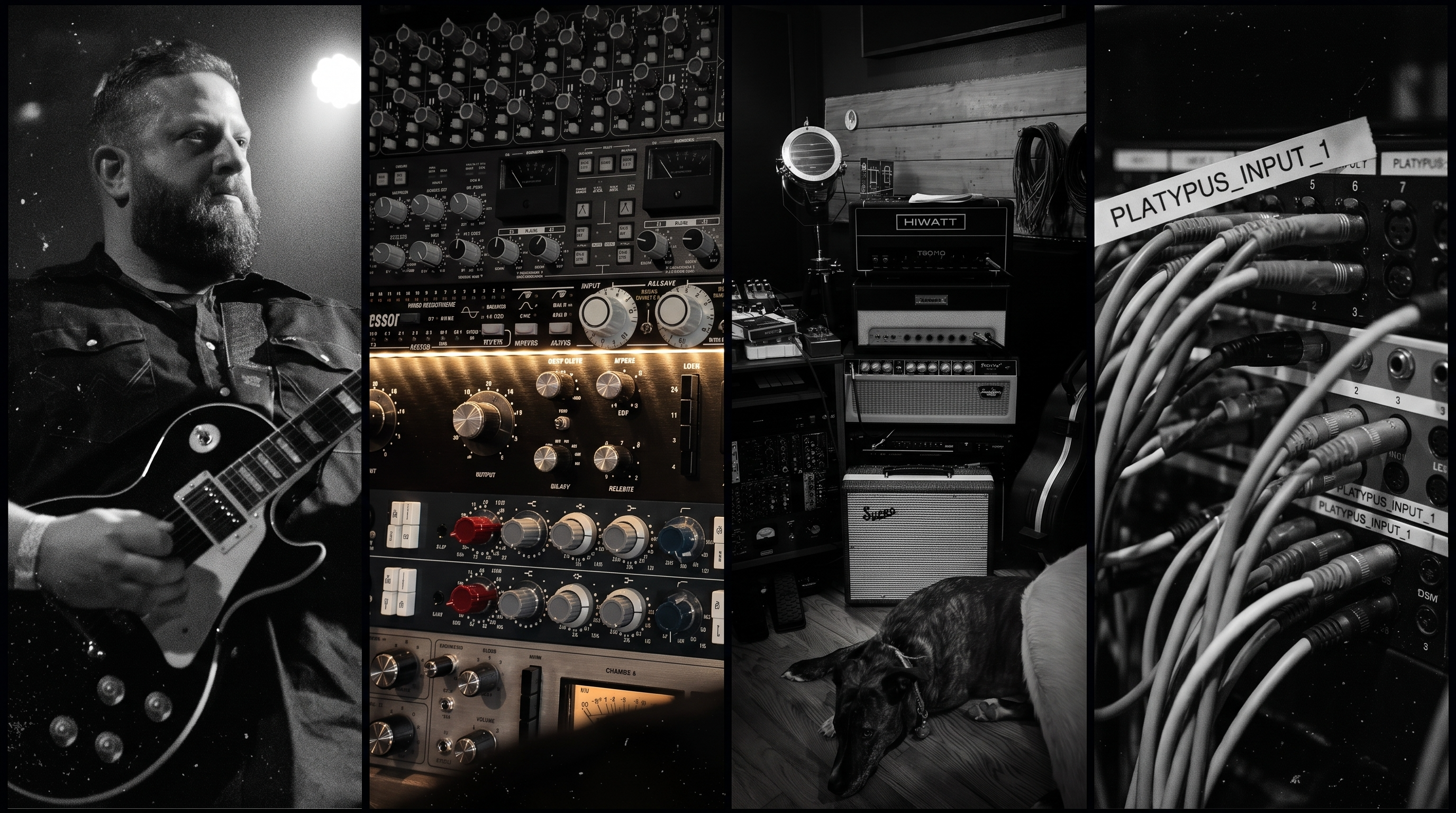
The only reason a private workspace can operate at this caliber with zero commercial overhead is because I refuse to outsource the engineering. I take total ownership of our technical infrastructure: I solder our custom cabling, maintain and repair our outboard gear, repair our tube amps, execute our instrument setups, and tune our acoustic piano. I built much of our studio furniture and hand-fabricated every high-end acoustic treatment panel on these walls. That resourcefulness guarantees the room always delivers exactly what a track demands.
06 // THE BEST POSSIBLE BUSINESS PARTNERS
Actually… The only reason Platypus Sound operates at this caliber is because of my wife, Kate. She deserves an incredible amount of credit for her patience, understanding, and belief in this space when it would have been simple to put her foot down years ago. Anyone who creates art knows you can't just have one foot in this life; music isn't an auxiliary hobby for me, it's what I live for. When I get to spend a dedicated day creating music, the payoff is immediate. I emerge as a sharper father, a better human being, and a more present husband for our family.
Physical Hardware Specification Vault
01 // CONSOLE SUMMING & PREAMPS
-
ASM164 Discrete Summing Mixer/ APIx1
-
1073 DPX Dual Channel Class-A Preamp/ AMS Nevex1
-
Color Duo Discrete Transistor Saturation/ DIYREx1
-
Autelir DT Direct Preamp Block/ Black Lion Audiox1
-
96-Point TT DB25 Structural Patchbays/ Redcox4
02 // COMPRESSORS
-
THE BUS+/ Solid State Logicx1
-
Distressor EL8-X/ Empirical Labsx2
-
V-Comp+ Vari-Mu/ Audio Scapex1
-
AS-2A/ Audio Scapex1
-
76D/ Audio Scapex1
-
AS78/ Audio Scapex1
-
E DYN 4000 B-Series/ Solid State Logicx1
-
FC526/ CAPIx1
-
GBUS/ DIYREx1
-
539/ Rupert Neve Designsx2
03 // EQUALIZERS
-
EQP-2A/ Audio Scapex1
-
BT50/ CAPIx2
-
Carnaby Harmonic EQ/ Cranbornex2
-
E-EQ 4000 Series/ Solid State Logicx2
-
80b Inductor EQ/ Tridentx4
-
LC40 / LC25 Induction EQ/ CAPIx4
04 // ANALOG SATURATION & PROCESSING
-
542 Tape Head Circuitry/ Rupert Neve Designsx2
-
BIG/ SPLx1
-
Vitalizer MKII/ SPLx1
-
ELDS/ Empirical Labsx1
-
Zulu Passive Tape/ Handsome Audiox1
05 // MIC LOCKER & ENVIRONMENT
-
TF47 Large-Diaphragm Tube Condenser/ Telefunkenx1
-
FC-387 Atlantis Condenser/ Lauten Audiox1
-
013 FET Matched Stereo Pair/ Soyuzx1
-
OX Amp Top Attenuator/ Universal Audiox1
06 // BACKLINE INSTRUMENTS & AMPLIFICATION
-
Imperial MKII/ Tone Kingx1
-
JTM Studio 20/ Marshallx1
-
T20/10/ HIWATTx1
-
1610RT Comet/ Suprox1
-
Stratocaster HSS (MIJ)/ Fenderx1
-
Les Paul Standard Solid Body (2011)/ Gibsonx1
-
American Professional Classic Jaguar/ Fenderx1
-
Blue CMa Acoustic Guitar/ Furchx1
-
American Jazz Bass 4-String Core/ Fenderx1
-
Take 5 Analog Polyphonic Circuit Synthesizer/ Sequentialx1
-
Acoustic Upright Piano/ Kimballx1